

Teaching a language online involves much more than sharing lesson materials and scheduling virtual classes. Learners need opportunities to practice speaking, develop listening skills, improve their vocabulary, receive meaningful feedback, and progress at a pace that matches their proficiency.
For language schools, universities, corporate training providers, and online learning businesses, managing all of this across multiple tools can quickly become overwhelming. As learner numbers grow, so does the complexity of managing courses, assessments, instructors, and individual learning journeys.
A learning management system (LMS) brings these activities together. However, not every LMS offers the flexibility, interactive learning capabilities, or administrative features that language programs require.
In this guide, we explore the eight best LMS platforms for language teaching and learning, their key features, benefits, limitations, and how to choose the right platform for your language training goals.
TL;DR: Best LMS Platforms for Language Teaching
| LMS platform | Best for | Key advantage |
|---|---|---|
| Open edX | Large-scale language learning programs | Customizable and scalable learning experiences |
| Totara | Corporate and professional language training | Skills-based learning and workforce development |
| Edly SaaS | Online language schools and learning businesses | Managed LMS with course authoring, administration and monetization |
| Moodle | Customized academic language programs | Extensive plugins and interactive activities |
| Canvas LMS | Universities and educational institutions | Blended learning and instructor feedback |
| iSpring LMS | Scenario-based language training | Interactive courses and dialogue simulations |
| TalentLMS | Small and midsized training organizations | Easy course management and delivery |
| Google Classroom | Independent teachers and small classrooms | Accessible and affordable classroom management |
Free resource: To help you choose the best LMS for your next language teaching program, we have created a free LMS for Language Teaching Comparison Scorecard.
What Is an LMS for Language Teaching and Learning?
A learning management system for language teaching is a digital platform that enables educators and organizations to create, deliver, manage, and evaluate language learning programs from a centralized environment.
Unlike standalone language learning applications that offer predefined lessons, an LMS gives educators control over their curriculum, teaching methodology, assessments, and learner experience.
Teachers can design courses around the four fundamental language skills: reading, writing, listening, and speaking. They can also incorporate vocabulary exercises, grammar assessments, recorded conversations, live classes, and collaborative learning activities.
For example, an online English language school could use an LMS to conduct placement tests, organize learners into beginner and advanced groups, deliver weekly lessons, schedule conversation classes, and award certificates upon successful course completion.
A well-configured LMS also allows organizations to offer self-paced, instructor-led, and blended language learning programs without managing separate systems for every activity.
Who Needs an LMS for Language Training?
Language learning requirements vary depending on the audience, teaching environment, and business objectives. An LMS can support several types of language training programs.
Online Language Schools
Language schools can use an LMS to manage multiple courses, instructors, enrollments, and proficiency levels. Schools offering paid courses can also benefit from integrated course catalogs, payment systems, and branded learning environments.
Universities and Higher Education Institutions
Universities can combine classroom instruction with digital language exercises, peer-reviewed assignments, multimedia lessons, and independent study. An LMS also helps faculty monitor academic progress across multiple semesters and programs.
Corporate Language Training Providers
Organizations can deliver role-specific language training to employees working across international markets. This might include business English, customer service communication, professional writing, or industry-specific terminology.
K-12 Schools
Schools can make language learning more engaging through interactive exercises, visual learning materials, storytelling, quizzes, and age-appropriate activities. Teachers can also identify students who need additional support.
EdTech Companies and Language Learning Businesses
Businesses developing digital language learning products can use an LMS as the foundation for their platform rather than building every learning and administrative feature from scratch.
Benefits of Using an LMS for Language Learning
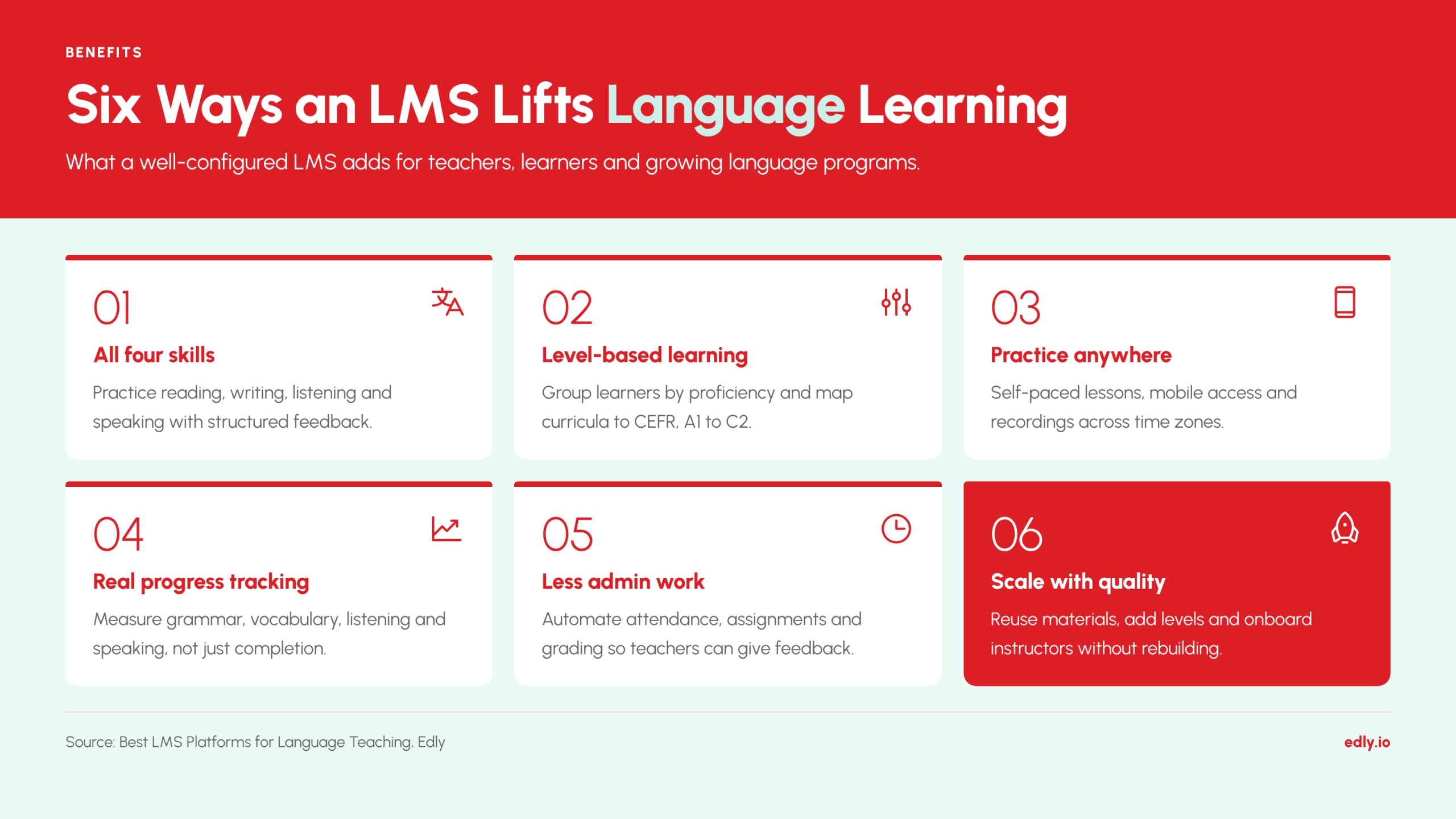
1. Develop All Four Language Skills
A suitable LMS can accommodate different instructional formats, allowing educators to design activities that develop reading, writing, listening, and speaking abilities.
Instead of relying exclusively on textbook exercises, learners can listen to authentic conversations, submit written responses, participate in speaking activities, and receive structured feedback.
2. Personalize Learning According to Proficiency Levels
Not every learner begins with the same vocabulary, grammatical knowledge, or communication skills.
An LMS can help educators organize students according to their existing proficiency and assign appropriate learning materials. Language programs can also structure their curricula around frameworks such as the Common European Framework of Reference for Languages (CEFR), from A1 to C2.
This reduces the likelihood of beginners feeling overwhelmed or advanced learners repeating material they already understand.
3. Make Language Practice More Accessible
Self-paced lessons, mobile access, recorded classes, and downloadable learning resources give students more opportunities to practice outside scheduled lessons.
This is particularly valuable for working professionals, international students, and learners across different time zones.
4. Track Actual Learning Progress
Course completion alone does not necessarily indicate language proficiency.
With appropriate assessments and reporting tools, instructors can evaluate grammar accuracy, vocabulary retention, listening comprehension, written communication, and speaking performance.
These insights help educators identify learning gaps and adjust their teaching strategies accordingly.
5. Reduce Administrative Work for Language Teachers
Managing attendance, distributing assignments, grading quizzes, and communicating with students can consume a significant portion of an instructor’s time.
An LMS can automate routine administrative activities, giving teachers more time to provide individualized feedback and conduct meaningful language practice.
6. Scale Language Programs Without Compromising Quality
As language programs expand into new regions, introduce additional courses, or enroll more students, an LMS helps maintain consistent course structures and administrative processes.
Organizations can reuse learning materials, introduce new proficiency levels, onboard instructors, and expand their offerings without rebuilding their entire learning infrastructure.
8 Best LMS Platforms for Language Teaching and Learning
The following platforms have been selected based on their course authoring capabilities, assessment tools, interactive learning support, customization options, scalability, and suitability for different language training environments.
1. Open edX: Best for Scalable and Customizable Language Learning Programs
Open edX is an open-source learning management platform particularly well suited to universities, language institutes, and EdTech businesses that want greater control over their digital learning experience.
One of the biggest advantages of Open edX for language teaching is its flexibility. Educators can develop structured language courses that combine multimedia content, interactive assessments, independent learning, and instructor-led activities.
Its modular architecture also allows organizations to introduce specialized language learning tools as their requirements evolve.
How Open edX Supports Language Teaching
- Interactive language exercises: Create grammar quizzes, vocabulary exercises, text-input assessments, and comprehension activities with automated feedback.
- Multimedia learning: Incorporate instructional videos, listening exercises, transcripts, and authentic conversations into course content.
- Proficiency-based learning: Organize learners into cohorts and deliver different learning materials according to their language abilities.
- Writing assessments: Use Open Response Assessments (ORA) to evaluate essays, written conversations, and other assignments through instructor, peer, or self-assessment.
- Blended language learning: Integrate compatible virtual classroom tools through Learning Tools Interoperability (LTI) for live speaking sessions and group discussions.
- Custom language learning tools: Extend the platform through XBlocks and integrations to introduce specialized pronunciation exercises, speech recognition, or AI-powered conversation practice.
Open edX’s assessment, cohort management, and integration capabilities provide a flexible foundation for developing these learning experiences.
Why Choose Open edX for Language Learning?
Consider a university planning to offer English, Spanish, and Arabic language programs to thousands of international learners.
With Open edX, the institution can develop separate curricula for each language, organize courses by proficiency level, reuse learning components, and integrate specialized assessment tools into a single learning environment.
The university retains greater control over its platform rather than adapting its teaching methodology to the limitations of a proprietary LMS.
This makes Open edX particularly attractive for organizations that consider their learning experience a long-term investment or a competitive differentiator.
Limitations
Open edX requires technical expertise for deployment, hosting, maintenance, and advanced customization. Specialized features such as automated pronunciation scoring and adaptive placement testing may require additional development or third-party integrations.
Pricing
The core Open edX software is open-source. Organizations need to budget for infrastructure, implementation, maintenance, integrations, and ongoing technical support.
Best for: Universities, large language institutes, EdTech companies, and organizations developing customized language learning platforms.
2. Totara: Best for Corporate and Professional Language Training
Totara is an enterprise learning platform designed to connect employee learning with organizational skills and performance requirements.
While many learning management systems focus primarily on course delivery, Totara is particularly useful for organizations that need language training to support measurable workplace objectives.
For multinational companies, hospitality businesses, healthcare organizations, and customer service teams, language proficiency can directly influence employees’ ability to perform their jobs.
Totara provides the tools to organize language development around these professional requirements.
How Totara Supports Language Training
- Role-based learning programs: Assign language training based on job roles, departments, locations, or organizational requirements.
- Individual learning plans: Develop personalized training plans according to employees’ existing language abilities and professional goals.
- Skills-based learning: Map language courses and learning activities to defined communication skills or competencies.
- Interactive learning activities: Use compatible H5P activities to create vocabulary exercises, interactive videos, and comprehension assessments.
- Seminar management: Organize instructor-led language workshops, speaking sessions, and blended training programs while managing participation and attendance.
- Advanced reporting: Monitor learning progress, course completion, assessment results, and training participation through configurable reports.
Totara Learn supports learning programs, certifications, learning plans, and skills-related learning activities. Organizations requiring more extensive skills and performance management can also consider Totara Perform.
Why Choose Totara for Language Learning?
Imagine an international hospitality company that needs to train employees in workplace English.
Reception staff may need conversational English for guest interactions, while managers may require advanced business communication skills. Housekeeping teams might need a more specialized vocabulary related to daily operations.
Instead of assigning the same language course to every employee, Totara allows the organization to create targeted training programs aligned with different responsibilities.
Managers can monitor training progress and identify employees who require additional support. Learning and development teams can also introduce refresher courses or recurring internal assessments where necessary.
For businesses operating across multiple regions, Totara can help establish a consistent approach to language development while accommodating different workforce needs.
Limitations
Totara’s enterprise-focused configuration may be unnecessary for independent teachers or small language schools. Advanced integrations, specialized language assessments, and customized proficiency frameworks may require implementation support.
Pricing
Totara uses a commercial subscription model. Costs depend on the selected products, organizational requirements, implementation scope, and support arrangements.
Best for: Corporate language training providers, multinational businesses, enterprise L&D departments, hospitality organizations, and professional training institutions.
3. Edly SaaS: Best for Launching and Growing Online Language Schools
Edly SaaS is a managed learning management solution built on Open edX. It brings together course authoring, learner administration, reporting, course discovery, and managed infrastructure within a single learning ecosystem.
For language training providers, managing the technology behind an online school can be as demanding as creating the courses themselves.
Edly SaaS addresses this challenge by allowing organizations to focus on teaching, learner engagement, and business growth rather than maintaining their own LMS infrastructure.
How Edly SaaS Supports Language Teaching
| Edly component | Benefit for language training providers |
|---|---|
| Edly LMS | Deliver structured language courses, assessments, multimedia lessons, and learning activities. |
| Edly Studio | Create, organize, update, and reuse language course content without developing courses from scratch technically. |
| Edly Panel | Manage learners, enrollments, administrative tasks, and learning reports. |
| Edly Discovery | Build a branded course storefront where prospective students can discover available language programs. |
| Edly Go | Give learners access to their courses through a mobile learning application, subject to the selected plan and setup. |
| E-commerce capabilities | Sell language courses and support paid learning offerings according to the selected configuration. |
| Certification | Award customized course completion certificates to successful learners. |
These components are part of Edly’s documented product ecosystem, with feature availability varying by subscription plan.
Why Choose Edly SaaS for Language Learning?
Suppose you run a language academy that currently delivers lessons through video conferencing software, shares assignments through email, and manually manages student registrations and payments.
As your student base grows, these disconnected processes become increasingly difficult to manage.
With Edly SaaS, you can bring much of your language school’s learning and administrative operations into one platform.
You could create beginner, intermediate, and advanced English courses, publish them through a branded storefront, enroll students, assign multimedia exercises, track their progress, and issue certificates upon completion.
Learners can access self-paced course materials between live classes, while instructors can focus on personalized feedback and conversation practice.
Edly’s Open edX foundation also provides a path toward more customized learning experiences if your language program eventually requires specialized functionality.
Key Benefits for Language Training Businesses
- Launch an online language academy without independently managing LMS infrastructure.
- Establish a branded learning experience that reflects your organization’s identity.
- Generate revenue through paid language courses.
- Reduce the technical workload associated with platform maintenance.
- Reach learners across different locations and time zones.
- Expand your course catalog as your language training business grows.
Limitations
Organizations requiring complete infrastructure control or highly specialized functionality may need a custom Open edX implementation instead. Features such as automated speech evaluation and AI conversation tutors should be assessed separately for integration and customization requirements.
Pricing
Edly SaaS offers subscription-based pricing with different features and support options depending on the selected plan.
Visit the Edly pricing and plans page for available options.
Best for: Online language schools, commercial training providers, education businesses, and organizations looking for a managed Open edX-based LMS.
4. Moodle: Best for Highly Customized Academic Language Programs
Moodle is an open-source LMS that gives educational institutions considerable flexibility in designing language learning experiences.
Its extensive plugin ecosystem and variety of learning activities make it particularly useful for educators who want to experiment with different language teaching methodologies.
Teachers can combine traditional instruction with interactive exercises, collaborative assignments, multimedia resources, and independent practice.
How Moodle Supports Language Teaching
- Interactive activities: Create vocabulary exercises, interactive videos, matching activities, and grammar exercises using H5P.
- Speaking assessments: Allow learners to submit audio and video recordings for instructor evaluation.
- Collaborative learning: Encourage written communication and peer interaction through forums and group activities.
- Custom assessments: Develop quizzes for grammar, vocabulary, reading, and listening comprehension.
- Flexible course progression: Structure learning around different proficiency levels and completion requirements.
- Plugin ecosystem: Extend the platform with specialized educational tools.
Moodle’s assignment functionality also supports audio and video submissions, making it particularly useful for asynchronous speaking assessments.
Why Choose Moodle for Language Learning?
Moodle is a strong option for educational institutions that want to give teachers greater freedom over course design.
For example, a French language instructor could create weekly vocabulary activities, assign recorded speaking exercises, organize written discussions, and provide individualized feedback within the same environment.
Its flexibility makes it suitable for institutions with established instructional design teams and technical resources.
Limitations
Managing plugins, maintaining infrastructure, and customizing the learner experience can increase technical complexity and long-term maintenance costs.
Pricing
Moodle LMS is open-source and free to download. Hosting, development, customization, and support costs vary.
Best for: Schools, universities, language institutes, and educational organizations requiring customizable learning experiences.
5. Canvas LMS: Best for Blended Language Learning in Higher Education
Canvas LMS is an education-focused learning management system widely suited to universities and schools that want to combine traditional classroom instruction with digital learning.
Its assignment management, communication tools, and instructor feedback capabilities make it a practical choice for academic language courses.
How Canvas Supports Language Teaching
- Multimedia assignments: Allow students to submit recorded conversations, oral presentations, and video assignments.
- Structured feedback: Evaluate writing and speaking performance using assessment rubrics.
- Course modules: Organize language lessons into progressive learning units.
- Collaborative learning: Encourage communication through discussions and group assignments.
- Blended learning: Combine classroom activities with online coursework and compatible virtual classroom tools.
- Grade management: Monitor assignment performance and academic progress.
Canvas supports audio and video assignment submissions, giving language instructors another way to assess communication skills outside the classroom.
Why Choose Canvas for Language Learning?
Canvas is particularly valuable when language learning forms part of a broader academic curriculum.
An instructor teaching academic English, for example, could assign research-based essays, assess recorded presentations, conduct peer-review activities, and provide detailed feedback throughout a semester.
Students can continue developing their language skills outside scheduled classroom hours while instructors maintain visibility into their progress.
Limitations
Organizations developing commercial language learning products or requiring highly specialized learning interfaces may need additional integrations and customization.
Pricing
Institutional pricing is generally available through a custom quote.
Best for: Universities, colleges, academic language departments, and schools offering blended learning programs.
6. iSpring LMS: Best for Scenario-Based Language Training
iSpring LMS is a learning management system designed to simplify the creation, delivery, and management of online training.
When combined with the iSpring Suite authoring toolkit, the platform becomes particularly useful for developing scenario-based language training that reflects real-life communication situations.
How iSpring LMS Supports Language Teaching
- Dialogue simulations: Create branching conversation scenarios where learners choose appropriate responses.
- Interactive assessments: Develop grammar, vocabulary, and comprehension quizzes.
- Multimedia courses: Incorporate instructional videos, audio recordings, and visual learning materials.
- SCORM support: Deliver compatible interactive courses created with external authoring tools.
- Learning reports: Monitor assessment performance and course completion.
- Mobile learning: Give learners access to training outside scheduled classes.
iSpring Suite supports role-play simulations that can be used to design practical communication exercises.
Why Choose iSpring LMS for Language Learning?
For organizations teaching business English or customer service communication, iSpring’s authoring tools can help recreate common workplace interactions.
Learners could practice responding to customer inquiries, participating in meetings, handling complaints, or selecting appropriate expressions during professional conversations.
These activities give learners opportunities to apply their language knowledge within a relevant context.
Limitations
Branching dialogue simulations do not necessarily evaluate spontaneous spoken communication. Organizations requiring advanced speech recognition or pronunciation scoring should evaluate additional tools.
Pricing
iSpring offers commercial subscription plans based on user requirements and selected authoring capabilities.
Best for: Corporate trainers, professional language training providers, and organizations offering scenario-based courses.
7. TalentLMS: Best for Small and Midsized Language Training Organizations
TalentLMS is a cloud-based learning management system that focuses on making online training accessible to organizations without extensive technical resources.
It offers course management, assessments, instructor-led training, learning paths, and reporting capabilities that can support a growing language training business.
How TalentLMS Supports Language Teaching
- Learning paths: Organize courses into progressive language training programs.
- Blended learning: Combine independent language exercises with live instructor-led sessions.
- Course creation: Develop lessons using text, videos, presentations, and interactive content.
- Gamification: Introduce points and achievement-based incentives to encourage regular participation.
- Branches: Create separate training environments for different customers or learner groups.
- Reporting: Monitor learner participation, completion rates, and assessment results.
TalentLMS supports structured learning paths, separate training portals, and instructor-led training, with availability depending on the selected plan.
Why Choose TalentLMS for Language Learning?
A language training provider working with multiple corporate clients could create separate learning environments for each customer.
Each organization could receive its own training materials, language courses, and administrative access while the training provider manages operations through a centralized platform.
This makes TalentLMS a practical option for providers that need manageable training operations without extensive platform development.
Limitations
Organizations requiring deep customization, specialized language assessment engines, or distinctive product experiences may find a more extensible LMS better suited to their long-term goals.
Pricing
TalentLMS offers different subscription plans based on user numbers and feature requirements.
Best for: Small and midsized language training providers, corporate training teams, and growing training businesses.
8. Google Classroom: Best for Independent Language Teachers and Small Classrooms
Google Classroom is a classroom management platform that integrates with Google Workspace tools to help educators organize lessons, assignments, communication, and feedback.
Although it lacks some of the capabilities of a comprehensive enterprise LMS, it is an accessible starting point for teachers who want to move their language classes online.
How Google Classroom Supports Language Teaching
- Live language classes: Conduct conversation sessions through Google Meet.
- Collaborative writing: Use Google Docs for essays, writing exercises, and collaborative activities.
- Online assessments: Create vocabulary and grammar quizzes using Google Forms.
- Multimedia assignments: Collect audio and video submissions for speaking exercises.
- Instructor feedback: Provide comments, corrections, and grades on student assignments.
- Classroom organization: Share lesson materials, announcements, and homework assignments.
Google Classroom supports multimedia assignment submissions and integrates with Google’s education tools for virtual instruction and assessment.
Why Choose Google Classroom for Language Learning?
For independent teachers or small language classes, Google Classroom provides a straightforward way to organize digital teaching activities without introducing a complex technology stack.
A Spanish language tutor could conduct weekly conversation classes through Google Meet, distribute worksheets, assign writing exercises, and collect recorded speaking assignments.
Limitations
Google Classroom is less suitable for organizations requiring integrated course monetization, sophisticated proficiency-based learning paths, extensive customization, or enterprise-level training management.
Pricing
Basic functionality is available at no cost. Google Workspace for Education Fundamentals is also free for qualifying institutions, while advanced editions are paid.
Best for: Independent language teachers, private tutors, small classrooms, and educational institutions already using Google Workspace.
Comparison of the Best LMS Platforms for Language Learning
The right platform depends on whether your priority is teaching effectiveness, operational efficiency, customization, or business growth.
| Platform | Customization | Learning model | Deployment | Pricing model |
|---|---|---|---|---|
| Open edX | High | Self-paced and blended | Self-hosted or managed | Open-source + implementation |
| Totara | High | Corporate and skills-based | Self-hosted or managed | Commercial subscription |
| Edly SaaS | Configurable, with custom extensions available separately | Self-paced and blended | Managed cloud | Subscription |
| Moodle | High | Academic and blended | Self-hosted or managed | Open-source + implementation |
| Canvas LMS | Configurable | Academic and blended | Typically cloud-based | Institutional pricing |
| iSpring LMS | Configurable | Scenario-based and blended | Cloud-based | Subscription |
| TalentLMS | Configurable | Corporate and blended | Cloud-based | Subscription |
| Google Classroom | Limited | Classroom and instructor-led | Cloud-based | Free and paid editions |
Essential LMS Features for Language Teaching and Learning
A general-purpose LMS may have dozens of features, but language training requires particular attention to how learners practice, communicate, and demonstrate their knowledge.
Here are the capabilities worth prioritizing when evaluating an LMS for language learning.
1. Support for All Four Language Skills
An effective language learning platform should accommodate activities that develop reading, writing, listening, and speaking.
| Language skill | Required LMS capabilities |
|---|---|
| Reading | Interactive text, comprehension quizzes, reading assignments |
| Writing | Text submissions, assessment rubrics, instructor feedback |
| Listening | Audio playback, video lessons, listening comprehension exercises |
| Speaking | Audio and video submissions, live classrooms, pronunciation tools |
Pay particular attention to speaking and listening capabilities. Many learning management systems handle text-based instruction well but require additional tools for oral language assessments.
2. Placement Tests and Proficiency-Based Learning Paths
Learners should be able to begin at a level appropriate to their existing abilities.
Look for an LMS that supports diagnostic assessments, learner groups, course prerequisites, and configurable learning pathways.
For organizations following the CEFR framework, the platform should allow educators to structure curricula and assessments around established learning objectives.
| CEFR level | Proficiency | Example learning objective |
|---|---|---|
| A1 | Beginner | Introduce yourself and understand basic expressions |
| A2 | Elementary | Communicate in routine everyday situations |
| B1 | Intermediate | Handle common conversations and familiar topics |
| B2 | Upper intermediate | Discuss complex topics with reasonable fluency |
| C1 | Advanced | Communicate effectively in academic and professional settings |
| C2 | Proficient | Understand and express complex ideas with precision |
These levels are based on the Council of Europe’s CEFR framework. Mapping courses to them requires appropriate instructional design and assessment criteria.
An LMS should support your progression model rather than force every learner through the same sequence of lessons.
3. Interactive Multimedia Content
Learning a language requires exposure to different voices, accents, expressions, and communication contexts.
Your LMS should support audio lessons, video conversations, interactive quizzes, visual vocabulary exercises, and other multimedia learning formats.
Features such as transcripts, playback controls, and captions can make these resources more accessible and useful for independent study.
4. Speaking Practice and Pronunciation Assessment
Speaking is often one of the most challenging skills to develop in an online language program.
An LMS should ideally support recorded speaking assignments, instructor-led conversation sessions, and structured feedback.
Depending on your teaching methodology, you may also want to integrate specialized technologies such as:
- Automatic speech recognition
- Pronunciation assessment
- AI-powered conversation tutors
- Interactive voice-based exercises
- Speech-to-text functionality
These capabilities are not standard across every LMS. Organizations should evaluate whether they are available natively, through integrations, or through custom development.
5. Live Classroom Integration
Language learning benefits from real-time interaction.
Virtual classroom integrations allow instructors to conduct conversation classes, group discussions, pronunciation workshops, and interactive lessons.
A blended learning model can be particularly effective because students can study vocabulary and grammar independently before applying their knowledge during instructor-led sessions.
6. Assessment and Personalized Feedback
Multiple-choice quizzes are useful for testing vocabulary and grammar, but they cannot fully evaluate communication skills.
Look for platforms that support open-ended assignments, multimedia submissions, peer assessments, configurable grading rubrics, and instructor feedback.
Teachers should be able to evaluate areas such as fluency, grammatical accuracy, vocabulary usage, listening comprehension, and written communication.
7. Learning Analytics and Proficiency Tracking
A student completing every lesson does not necessarily mean they can communicate effectively in the target language.
Your LMS should help instructors distinguish between participation and actual learning outcomes.
Useful metrics include assessment scores, progression between proficiency levels, recurring errors, assignment performance, and instructor-assessed communication abilities.
These insights help educators identify struggling learners and provide targeted support.
8. Mobile Learning and Accessibility
Language learners often practice in short sessions throughout the day.
A mobile-friendly learning experience allows students to review vocabulary, listen to recordings, and complete exercises between scheduled lessons.
Accessibility is equally important. Consider screen reader compatibility, keyboard navigation, captions, transcripts, adjustable text sizes, and support for learners with different needs.
9. Multilingual Interface and Localization
A language learning platform may serve learners from different linguistic and cultural backgrounds.
Multilingual interfaces, localized notifications, Unicode support, and compatibility with right-to-left languages can make the platform easier to navigate.
For international language schools, localization can also support expansion into new markets without creating an entirely separate learning platform.
10. E-commerce and Course Monetization
For commercial language training providers, the LMS also needs to support the business behind the learning experience.
Integrated course catalogs, payment gateways, subscription management, branded storefronts, and enrollment processes can help organizations sell their courses more efficiently.
This is particularly relevant for online language academies offering paid courses, certification preparation, and professional language training programs.
How AI Is Changing LMS Platforms for Language Learning
Artificial intelligence is introducing new ways for language learners to practice independently and receive feedback outside instructor-led sessions.
Traditional language training often depends on how much time teachers can dedicate to individual students. AI-powered tools can supplement that instruction by providing additional practice opportunities.
Some of the most relevant applications include:
| AI capability | Benefit for language learners |
|---|---|
| AI conversation tutors | Practice conversations outside scheduled classes |
| Automated pronunciation feedback | Identify potential pronunciation errors and repeat exercises |
| AI-assisted writing feedback | Identify grammatical issues and improve written expression |
| Adaptive learning | Recommend exercises based on identified learning gaps |
| AI course authoring | Help instructors prepare practice materials and assessments |
| Speech recognition | Convert spoken responses into text for further analysis |
However, AI-generated feedback should complement qualified language instruction rather than replace it.
Accuracy can vary across languages, accents, and communication contexts. Organizations should also evaluate learner privacy, audio data handling, accessibility, and the reliability of automated assessments before introducing these tools.
For organizations planning to develop advanced AI-powered language learning experiences, extensible platforms such as Open edX provide a foundation for integrating specialized technologies instead of rebuilding the entire LMS.
How to Choose the Right LMS for Language Teaching
Selecting the right LMS begins with understanding how your organization teaches languages and what it expects learners to achieve.
Identify Your Learning Audience
An LMS designed for university students may not be the best choice for employees learning business English.
Define whether your audience consists of children, university students, working professionals, independent learners, or corporate customers.
This will influence your requirements for course structure, assessments, engagement, and administration.
Define Your Language Teaching Methodology
Determine whether your programs are primarily self-paced, instructor-led, or blended.
If speaking practice is central to your methodology, prioritize virtual classrooms, multimedia submissions, and communication tools. If your focus is independent learning, interactive exercises and structured progression may be more important.
Consider Your Business and Operational Requirements
Language training businesses should evaluate how the platform handles course sales, student registration, instructor management, reporting, and branding.
Enterprise training departments may instead prioritize HR integrations, role-based training assignments, skills tracking, and manager visibility.
Evaluate Customization and Integration Capabilities
Your initial requirements may be straightforward, but they are likely to evolve as your language program grows.
Assess whether the LMS can accommodate new assessment methods, specialized language learning tools, AI integrations, and different learning models.
A flexible architecture can reduce the likelihood of having to migrate to another platform when your requirements change.
Calculate the Total Cost of Ownership
The subscription or licensing fee represents only part of the investment.
Consider the following costs when comparing platforms:
- Initial implementation and configuration
- Hosting and infrastructure
- Course content development
- Third-party software and integrations
- Custom feature development
- Instructor and administrator training
- Technical support and ongoing maintenance
- Future scalability and platform upgrades
An open-source LMS may have no core licensing fee but require greater implementation investment. A SaaS LMS may reduce infrastructure responsibilities through recurring subscription costs.
Test the Platform With a Real Language Course
Before committing to an LMS, run a pilot using an actual language course.
Ask your instructors to create lessons, upload listening exercises, conduct a speaking assessment, grade written assignments, and monitor learner progress.
Evaluate the experience from both the instructor’s and student’s perspectives.
A platform demonstration can show you what a product offers. A practical pilot reveals how well it supports your teaching methodology.
Open edX vs. Totara vs. Edly SaaS: Which Is Right for Your Language Training Program?
Although all three platforms can support language learning, they address different organizational priorities.
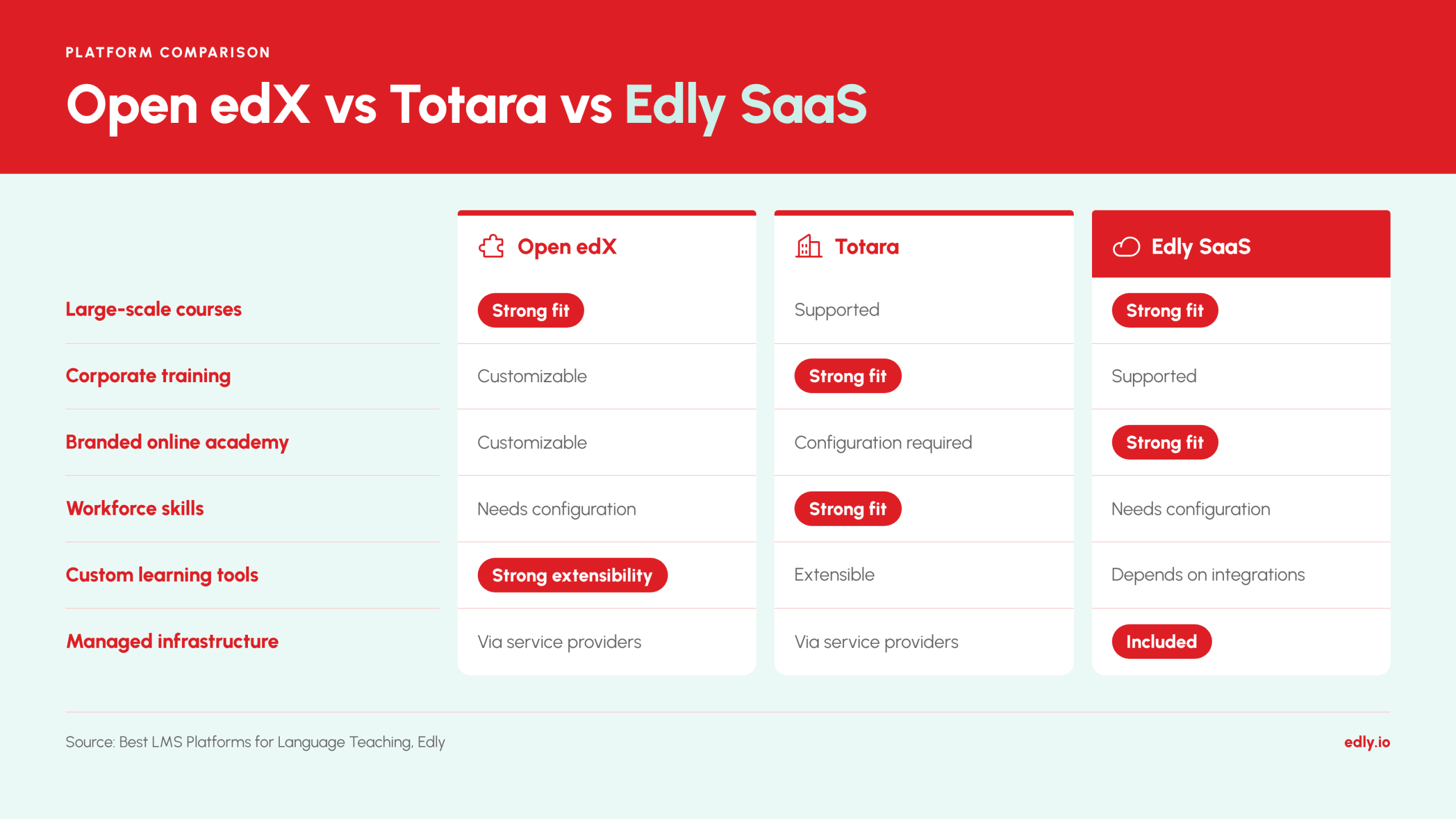
| Requirement | Open edX | Totara | Edly SaaS |
|---|---|---|---|
| Large-scale online language courses | Strong fit | Supported | Strong fit |
| Corporate language training | Customizable | Strong fit | Supported |
| Branded online language academy | Customizable | Configuration required | Strong fit |
| Workforce skills management | Requires configuration or integrations | Strong fit | Requires additional configuration |
| Custom language learning tools | Strong extensibility | Extensible | Depends on integration requirements |
| Integrated course monetization | Requires appropriate setup | Integration or configuration dependent | Available on applicable plans |
| Managed infrastructure | Available through service providers | Available through service providers | Included in SaaS offering |
| Infrastructure-level control | Available with self-hosting | Depends on deployment | Managed by provider |
Choose Open edX if you want to build a differentiated language learning platform with extensive customization, specialized learning experiences, and long-term control over your technology.
Choose Totara if your language training programs need to align with employee responsibilities, professional skills, workforce development, and organizational performance.
Choose Edly SaaS if you want to launch and grow an online language training business without taking on the responsibility of independently managing LMS infrastructure.
How Much Does an LMS for Language Training Cost?
The cost of an LMS for language teaching depends on the number of learners, deployment model, customization requirements, and complexity of the learning experience.
There are generally four pricing approaches.
| LMS model | Cost considerations |
|---|---|
| Free classroom management tools | Limited functionality, with possible costs for advanced features |
| Open-source LMS | Hosting, implementation, customization, maintenance, and support |
| SaaS LMS | Recurring subscription, plan limits, integrations, and optional add-ons |
| Enterprise LMS | Commercial licensing, implementation, integrations, and support |
Specialized language learning functionality, such as AI conversation tutors, speech recognition, automated pronunciation assessment, and adaptive placement testing, can introduce additional costs.
Rather than selecting the platform with the lowest upfront price, evaluate how much it will cost to operate and expand your language training program over time.
Build a Language Learning Experience That Goes Beyond Course Delivery
Choosing the best LMS for language teaching comes down to how effectively the platform supports your learners, instructors, and organizational goals.
Independent teachers may find Google Classroom sufficient. Academic institutions may benefit from Canvas or Moodle. Organizations offering professional training may prefer iSpring LMS or TalentLMS.
However, for organizations building scalable language learning programs, developing customized educational experiences, or expanding their online training businesses, Open edX, Totara, and Edly SaaS offer distinct advantages.
At Edly, we help educational institutions, training providers, and learning businesses implement LMS solutions around their specific requirements.
Whether you need a customized Open edX platform, an enterprise language training solution powered by Totara, or a managed learning ecosystem through Edly SaaS, our team can help you identify and implement the right technology for your learning goals.
Talk to Edly’s LMS experts to find the right solution for your language training program.
Frequently Asked Questions
What is the best LMS for language teaching?
Open edX, Totara, Edly SaaS, Moodle, Canvas, iSpring LMS, TalentLMS, and Google Classroom are all suitable options for different language teaching requirements. Open edX is particularly suitable for customized learning experiences, Totara for corporate language training, and Edly SaaS for online language schools requiring a managed platform.
What is the best LMS for online language schools?
Edly SaaS is a strong option for online language schools that require course authoring, learner management, reporting, branded storefronts, and course monetization within a managed learning ecosystem. Open edX is suitable for schools requiring greater platform customization and infrastructure control.
Can Open edX be used for language learning?
Yes. Open edX supports multimedia lessons, interactive assessments, learner cohorts, discussion activities, and external learning tool integrations. Its extensible architecture also allows organizations to introduce specialized language learning functionality through custom development.
Is Totara suitable for language training?
Yes. Totara is particularly suitable for corporate and professional language training. Its learning programs, individual learning plans, seminar management, skills frameworks, and reporting tools can help organizations align language development with workforce requirements.
What is the best free LMS for language teaching?
Google Classroom is an accessible starting point for teachers requiring basic classroom management functionality. Moodle and Open edX also provide open-source LMS software, although organizations must account for hosting, implementation, and maintenance costs.
Can an LMS support CEFR-based language learning?
Yes. A configurable LMS can support CEFR-based curricula by organizing courses around proficiency levels, establishing progression requirements, and mapping assessments to defined language learning outcomes. CEFR alignment must be established through appropriate curriculum design and assessment methods.
Can an LMS assess speaking and pronunciation?
Many LMS platforms support audio and video submissions that instructors can evaluate using grading rubrics. Automated pronunciation scoring and speech recognition generally require specialized tools, integrations, or custom development.
Can I sell language courses through an LMS?
Yes. Platforms such as Edly SaaS offer e-commerce capabilities on applicable plans, allowing language training providers to publish and sell courses through their learning platforms. Payment options and monetization features vary across LMS providers.
What is the difference between an LMS and a language learning app?
A language learning app typically provides predefined language lessons directly to learners. An LMS gives educators and organizations the tools to create their own curricula, manage learners, conduct assessments, deliver training, and monitor learning outcomes.
Can AI be integrated into an LMS for language teaching?
Yes. Depending on the platform’s architecture and integration capabilities, organizations can introduce AI conversation tutors, speech recognition, automated writing feedback, personalized practice exercises, and AI-assisted course authoring.
