

Choosing a learning management system (LMS) is no longer just about finding a platform where you can upload courses and track learner progress. Organizations now need learning platforms that support different learning experiences, integrate with existing systems, and adapt as their training requirements grow.
This is where open-source LMS platforms like Open edX and Moodle come into the picture.
Both platforms offer extensive customization options, active developer communities, and the freedom to build learning experiences without relying entirely on proprietary software. However, they take different approaches to course delivery, platform architecture, and learning management.
Moodle has traditionally been popular for structured, instructor-led education, while Open edX has established itself as a strong choice for large-scale online learning and self-paced courses.
So, when comparing Open edX vs Moodle, which platform makes more sense for your organization?
In this guide, we’ll explore nine key differences between these open-source LMS platforms, compare their features and costs, and help you determine which one aligns with your learning goals in 2026.
TL;DR
- Open edX is best suited for large-scale online learning, self-paced courses, MOOCs, and customized learning platforms.
- Moodle is ideal for instructor-led learning, academic institutions, structured assessments, and classroom management.
- Both are open-source LMS platforms, but implementation, hosting, customization, and maintenance contribute to their total cost of ownership.
- Open edX offers extensive customization through APIs, XBlocks, and its modern architecture, while Moodle provides a mature ecosystem of ready-made plugins.
- In 2026, both platforms are expanding their AI capabilities, integrations, and learning management features.
- The right LMS depends on your learning delivery model, scalability requirements, technical resources, budget, and long-term business goals.
Open edX vs Moodle: Which Is Better?
Open edX is generally a better fit for organizations developing scalable, self-paced online learning programs, while Moodle is particularly well-suited to institutions that prioritize instructor-led courses, assignments, grading, and structured learning management.
Both platforms can support large learner populations and offer extensive customization. The right choice depends on how you plan to deliver learning, the integrations you need, your technical resources, and your long-term goals.
For example, a university launching online courses for learners worldwide may benefit from Open edX’s course delivery architecture. Meanwhile, a school looking to manage classroom assignments, assessments, and student grades may find Moodle more aligned with its everyday requirements.
What Is Open edX?
Open edX is an open-source learning management system originally developed through an initiative by Harvard University and MIT. It powers edX.org and is used by universities, businesses, governments, and educational organizations to create and deliver online learning programs.
The platform includes Open edX Studio for course creation and a learner-facing LMS for delivering content, assessments, discussions, and other learning activities.
One of its distinguishing characteristics is its focus on interactive and large-scale online learning.
Organizations can use Open edX to build self-paced courses, professional certification programs, employee training academies, and massive open online courses (MOOCs).
Its capabilities can be extended through XBlocks, APIs, integrations, and custom development to accommodate more specialized learning requirements.
The platform has also demonstrated significant global adoption. According to the Open edX community, the ecosystem surpassed 100 million learners in May 2025, showing how widely the technology is used for online education.
What Is Moodle?
Moodle is an open-source learning management system founded by Martin Dougiamas in 2002. It is widely used by schools, universities, and organizations to manage online courses, classroom activities, assessments, and training programs.
Unlike platforms built primarily around large-scale self-paced learning, Moodle places considerable emphasis on the day-to-day activities of teachers and learners.
Instructors can organize courses by topics or weeks, assign activities, evaluate submissions, manage grades, and communicate with students through a centralized learning environment.
Moodle also offers a large plugin ecosystem, allowing organizations to extend the platform with additional functionality.
Beyond the self-hosted Moodle LMS, organizations can explore MoodleCloud for hosted deployments and Moodle Workplace for enterprise learning requirements.
Moodle’s reach is substantial, with hundreds of millions of registered users across its global network of learning sites. Its popularity reflects its usefulness for both traditional educational environments and organizational training.
Open edX vs Moodle: A Quick Comparison
Before exploring the differences in detail, here’s how these two open-source LMS platforms compare across important criteria.
| Feature | Open edX | Moodle |
|---|---|---|
| Primary use case | Large-scale online and self-paced learning | Instructor-led and structured course management |
| Technology | Python, Django, React | PHP |
| Open-source licensing | Primarily AGPLv3, with some Apache 2.0 components | GPL |
| Course creation | Open edX Studio | Moodle course editing tools |
| Scalability | Designed for large online learning programs | Supports small to large institutional deployments |
| Customization | XBlocks, APIs, plugins, custom frontends | Extensive plugin directory and themes |
| Learning experience | Video-based, interactive, self-paced learning | Assignments, grading, activities, blended learning |
| Analytics | Open edX Aspects and other integrations | Report builder and additional reporting tools |
| AI capabilities | Extensible AI integrations and emerging framework | Core AI subsystem with configurable providers |
| Accessibility | Accessibility guidance and supported platform features | WCAG-focused development and audited accessibility conformance |
| Authentication | Multiple authentication and SSO integration options | Built-in authentication plugins and role permissions |
| Hosting | Self-hosted or managed hosting | Self-hosted, MoodleCloud, or managed hosting |
| Latest major release as of November 2026 | Verawood | Moodle 5.3 LTS |
Both platforms have advantages. However, understanding where they differ can help organizations avoid investing in a learning platform that doesn’t support their long-term requirements.
9 Key Differences Between Open edX and Moodle
1. Technology and Platform Architecture
One of the biggest differences between Open edX and Moodle is the technology used to build and maintain each platform.
Open edX is primarily built using Python and Django, with React-based frontend applications. This architecture supports extensive customization and integration with modern web services.
Python also has a well-established ecosystem for AI, automation, and data processing. This can be useful for organizations planning to connect their learning platforms with AI-powered assistants, recommendation systems, or advanced analytics tools.
Moodle, on the other hand, is built primarily using PHP and follows a more traditional web application architecture.
PHP has a mature development ecosystem and is supported by a wide range of hosting providers. Organizations with existing PHP expertise may find Moodle more convenient to maintain and extend.
The difference becomes particularly important when planning custom LMS development.
Organizations investing in complex integrations or data-driven learning products may prefer Open edX’s technology stack. Teams with established PHP capabilities and conventional learning management requirements may find Moodle more practical.
The key takeaway: Neither programming language automatically makes an LMS better. Your existing technical expertise, integration requirements, and future development plans should guide the choice.
2. Scalability and Learner Management
Scalability is often one of the first considerations when comparing Moodle vs Open edX.
Open edX was developed with massive online courses in mind. Its architecture supports learning programs that may attract thousands of learners simultaneously and potentially much larger audiences over time.
This makes it attractive for universities offering public online courses, organizations running large-scale certification programs, and businesses building digital learning academies.
For example, a training provider planning to offer 200 courses to learners across multiple countries may benefit from Open edX’s support for self-paced learning, course discovery, and extensible integrations.
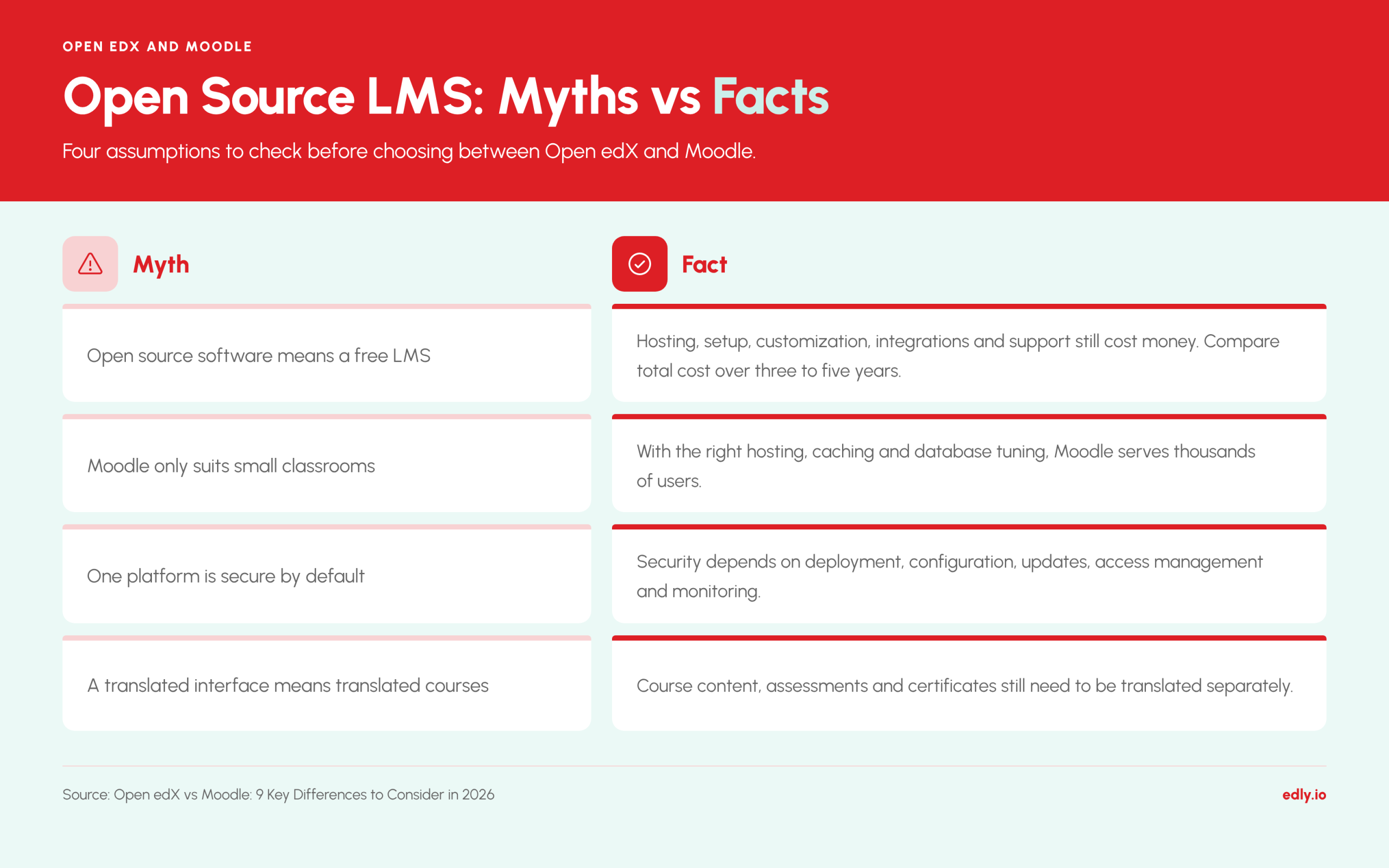
However, this doesn’t mean Moodle is limited to small classrooms.
Moodle also supports large-scale deployments and is used by major educational institutions worldwide. With appropriate hosting infrastructure, caching, database optimization, and performance planning, Moodle can serve substantial learner populations.
The real distinction lies in how the platforms approach learning delivery.
Open edX is particularly well suited to programs designed for broad, distributed learner audiences. Moodle is especially effective when courses revolve around teachers, enrolled cohorts, assessments, and ongoing classroom management.
Which one is better for scalability? Both can scale, but Open edX may be a more natural fit for MOOC-style programs, while Moodle is well suited to scaling structured institutional learning.
3. Course Creation and Learning Experience
An LMS should do more than store educational content. It should help organizations create learning experiences that keep learners engaged and support measurable outcomes.
Both Open edX and Moodle offer course authoring tools, but their approaches differ.
Open edX focuses strongly on interactive and self-paced learning experiences.
Through Open edX Studio, educators can organize courses into sections, subsections, and units containing videos, assessments, discussions, readings, and interactive learning components.
The platform also supports extensions such as XBlocks, which allow developers to introduce additional content types and learning activities.
For instance, an organization offering an online software development certification could combine instructional videos, coding exercises, quizzes, and progress-based assessments within a single course.
Moodle takes a more instructor-centered approach.
Teachers can organize courses using weekly or topic-based formats, manage assignments, conduct quizzes, create discussion forums, and maintain gradebooks.
This structure works particularly well for institutions where instructors actively manage student progress throughout an academic term.
For example, a university professor can use Moodle to distribute weekly readings, collect assignments, conduct assessments, and publish grades.
Both platforms can support blended learning. However, Open edX tends to be a strong fit for structured self-paced online programs, while Moodle provides extensive tools for instructor-led course administration.
4. Customization and User Experience
One of the main reasons organizations choose an open-source LMS is the freedom to customize it according to their requirements.
Both Open edX and Moodle allow customization, although the processes and technical demands can differ.
Open edX provides flexibility through its APIs, XBlocks, extension points, and frontend architecture. Organizations can customize course interfaces, integrate external tools, and develop learning experiences aligned with their brand.
For example, an EdTech company could customize its Open edX platform to offer a branded learning portal with specialized onboarding, learner dashboards, and integrated payment workflows.
However, significant changes may require experienced Open edX developers or a specialized service provider.
Moodle offers a broad ecosystem of plugins and themes that can simplify certain customization tasks.
Organizations can install compatible plugins to add functionality such as additional enrollment methods, reporting features, and interactive activities without building everything from scratch.
That said, extensive Moodle customization may still require professional development, particularly when multiple plugins, custom workflows, and third-party systems are involved.
Which is easier to customize? Moodle can be more accessible for organizations relying on existing plugins. Open edX offers substantial flexibility for teams building differentiated online learning products and experiences.
5. Accessibility and Inclusive Learning
Accessibility is an important consideration for any organization planning to deliver education to a diverse audience.
An accessible LMS helps learners with different abilities access content, navigate courses, complete assessments, and participate in learning activities.
Open edX provides accessibility guidance for course authors and developers, along with platform capabilities intended to support inclusive learning.
Organizations can use these resources when designing accessible course content, customizing interfaces, and evaluating their platforms against relevant accessibility requirements.
Moodle also places a strong emphasis on accessibility.
Its accessibility initiatives include external audits, published conformance documentation, and the Brickfield accessibility toolkit. Moodle has reported WCAG 2.2 Level AA accreditation for applicable audited releases.
However, accessibility isn’t determined by the LMS alone.
Poorly structured course materials, videos without captions, inaccessible documents, and incompatible third-party plugins can create barriers regardless of the platform selected.
Organizations should therefore evaluate both the accessibility of the LMS and the content they plan to deliver.
The key takeaway: Both platforms support accessible learning. The right choice depends on the accessibility requirements of your organization and how well your final implementation meets them.
6. Plugins, Integrations, and Extensibility
As organizations expand their learning programs, they often need their LMS to connect with other business and educational systems.
These may include customer relationship management (CRM) software, human resource management systems (HRMS), payment gateways, virtual classroom tools, and analytics platforms.
Open edX supports integrations through APIs, XBlocks, plugins, and interoperability standards such as Learning Tools Interoperability (LTI).
Its Verawood release achieved LTI Advantage Complete certification, reinforcing support for integrations with compatible external educational tools.
Moodle also offers extensive integration capabilities, supported by its plugin directory and established APIs.
Organizations can extend the platform with tools for attendance, authentication, reporting, communication, content delivery, and other learning activities.
An important consideration is the effort required to maintain these integrations.
While plugins can reduce development time, organizations still need to evaluate compatibility, security updates, and performance impacts.
Likewise, custom Open edX integrations require appropriate development and ongoing maintenance.
Which LMS offers better integrations? Moodle provides a large selection of ready-made extensions, while Open edX is well suited to organizations that need deeper customization and tailored integration workflows. Both support enterprise integrations.
7. Security, Authentication, and Data Privacy
When an LMS stores learner information, assessment results, and organizational training records, security becomes a critical requirement.
Both Moodle and Open edX offer authentication, authorization, and administrative security capabilities.
Open edX supports multiple authentication methods and can be integrated with external identity management systems, including single sign-on solutions.
Organizations can also establish role-based access to manage the permissions of learners, course teams, and administrators.
Moodle includes built-in authentication capabilities through plugins supporting methods such as LDAP, OAuth 2, and other external identity providers.
It also has a well-established roles-and-capabilities system for controlling access to platform features.
This means organizations shouldn’t assume that one platform is inherently secure simply because of its underlying technology.
Both require appropriate configuration, software updates, hosting security, access management, and monitoring.
Data privacy requirements, including GDPR where applicable, also depend on how the LMS is deployed and managed.
Which is more secure, Open edX or Moodle? Both provide security and authentication capabilities. Actual security depends largely on deployment architecture, configuration, integrations, maintenance, and operational practices.
8. Community Support and Target Audience
The availability of technical expertise, documentation, and community support can influence the long-term success of an LMS implementation.
Both platforms benefit from active open-source communities, but their ecosystems have different strengths.
Open edX is commonly used by universities, government organizations, online education providers, and businesses offering large-scale digital learning.
Its community includes developers, educators, technology partners, and organizations contributing to the platform’s ongoing development.
Organizations can also work with experienced Open edX service providers for implementation, hosting, customization, and support.
Moodle has an extensive global community of educators, administrators, developers, and certified service providers.
Its long-standing adoption across schools, colleges, universities, and corporate learning environments means organizations can access substantial documentation, plugins, and implementation resources.
For institutions with internal technical teams, both communities offer valuable opportunities for collaboration and development.
For organizations without dedicated LMS expertise, selecting a reliable implementation partner may be just as important as choosing the platform itself.
9. Multilingual Support and Global Reach
Organizations serving international learners need an LMS capable of delivering content across different languages and regions.
Both Open edX and Moodle provide multilingual capabilities.
Open edX uses community-supported translation workflows, including Transifex and translation management tools, to make its interface available in multiple languages.
Its translation ecosystem includes projects covering more than 100 languages, although translation completeness varies between languages and components.
Moodle also supports multilingual learning environments through downloadable language packs.
Its language ecosystem includes more than 100 language options, with certain languages offering regional or formal and informal variations.
However, translating the LMS interface doesn’t automatically translate the course material.
Organizations still need to develop or translate instructional content, assessments, certificates, and other learning resources.
Which LMS is better for multilingual learning? Both support international audiences. Organizations should compare translation coverage, content localization requirements, and language support for their chosen plugins before making a decision.
Open edX vs Moodle in 2026: What’s New?
Learning management systems are evolving beyond traditional course delivery.
AI-powered assistance, reusable content, advanced reporting, and improved learning experiences are becoming important considerations for organizations evaluating modern LMS platforms.
Recent updates to both Open edX and Moodle reflect these changing expectations.
Open edX Verawood: A More Flexible Learning Platform
Released in July 2026, Open edX Verawood introduced improvements to platform administration, course management, analytics, and extensibility.
Notable developments include:
- A redesigned Instructor Dashboard to simplify course management.
- New course-level roles to provide more granular permissions.
- Updates to the platform’s frontend architecture.
- Improvements to notifications and learning analytics.
- An emerging AI extensibility framework for developing AI-powered learning functionality.
The release also continues the platform’s broader modernization efforts.
For organizations considering Open edX LMS development, these improvements provide additional opportunities to create customized learning experiences.
However, certain new capabilities, particularly experimental AI functionality, may require technical evaluation before production deployment.
Moodle 5.3 LTS: A Focus on Stability and Learning Management
Moodle 5.3 LTS, released in October 2026, provides a long-term-support option for organizations planning their platform upgrades.
Moodle’s recent 5.x development has also introduced improvements across course management, reporting, administration, and AI configuration.
For example, Moodle 5.1 expanded AI management capabilities, including more granular controls for AI access within courses and activities.
Together, these developments give organizations more options for integrating emerging technologies into established learning workflows.
The long-term-support release is particularly relevant for institutions that prioritize predictable maintenance cycles and extended security support.
AI Capabilities: Open edX vs Moodle
AI is becoming another important factor in LMS selection.
Moodle includes a core AI subsystem that allows administrators to configure supported AI providers and control access to AI functionality.
Open edX, meanwhile, supports AI capabilities through integrations and an emerging extensibility framework. Organizations can build or integrate functionality such as learning assistants, personalized support, and AI-enhanced course tools.
Neither platform automatically provides every AI use case out of the box.
The availability of specific AI capabilities depends on the release, enabled services, plugins, and customization work involved.
For organizations planning advanced AI-enabled learning products, Open edX offers a flexible development foundation. Moodle may be more convenient for institutions looking to introduce supported AI functions within existing course management workflows.
Open edX vs Moodle Pricing: Which Is More Cost-Effective?
Cost is another important factor when choosing between Open edX and Moodle.
Both platforms are open source, which means organizations can use their underlying software without paying traditional proprietary LMS licensing fees.
However, free software doesn’t mean a free LMS implementation.
Organizations still need to account for hosting, configuration, customization, integrations, maintenance, and technical support.
Open edX Pricing
Open edX can be self-hosted or deployed through a managed service provider.
The overall cost depends on several factors, including:
- Number of learners and expected concurrent users.
- Hosting infrastructure and performance requirements.
- Course complexity and required integrations.
- Custom UI/UX development.
- Security, upgrades, and ongoing maintenance.
- Managed hosting and technical support.
A straightforward managed deployment may be considerably less expensive than a highly customized enterprise learning platform.
Organizations should therefore compare implementation packages and total operating costs rather than relying on a single generic Open edX pricing figure.
Moodle Pricing
Moodle’s core software is also available without licensing fees.
Organizations can deploy it on their own infrastructure, use a managed Moodle hosting provider, or choose MoodleCloud.
MoodleCloud offers subscription plans for smaller learning environments, with published plans accommodating different user and storage limits.
For organizations with relatively straightforward requirements, this can provide a convenient starting point.
However, larger deployments may require more infrastructure, integrations, and customization, increasing the total cost.
Open edX vs Moodle: Cost Comparison
| Cost factor | Open edX | Moodle |
|---|---|---|
| Software license | Free | Free |
| Self-hosting | Available | Available |
| Managed hosting | Through service providers | MoodleCloud and service providers |
| Initial setup | May require specialist expertise | Often simpler for standard deployments |
| Customization | Depends on development requirements | Plugin-based or custom development |
| Ongoing maintenance | Hosting, upgrades, support | Hosting, upgrades, support |
| Enterprise costs | Based on requirements and scale | Based on requirements and scale |
Which is cheaper, Moodle or Open edX?
Moodle may offer a lower-cost starting point for smaller organizations with conventional course management needs, particularly through its hosted offerings.
Open edX can be a worthwhile investment for organizations building scalable online learning programs that require substantial customization and integration.
Rather than comparing software license costs alone, organizations should evaluate the total cost of ownership over three to five years, including implementation, infrastructure, maintenance, and future enhancements.
Open edX or Moodle: Which LMS Should You Choose?
Choosing the right LMS depends on what your organization wants to accomplish.
A platform that works well for a university managing semester-based courses may not be the best choice for a business launching a global professional learning academy.
Here’s how to evaluate both options based on common use cases.
Open edX vs Moodle for Universities
Universities can benefit from both platforms, but their preferred learning model matters.
Moodle is often a strong choice for managing traditional university courses, including assignments, assessments, gradebooks, and instructor-student communication.
Open edX may be more suitable for universities launching online degree-related programs, continuing education courses, MOOCs, and professional certifications for broader audiences.
Universities offering both classroom-based education and public online learning may even find value in using the platforms for different purposes.
Open edX vs Moodle for Corporate Training
For corporate training, the decision depends on how learning programs are structured and delivered.
Moodle, particularly with Moodle Workplace or suitable enterprise extensions, can support employee training, compliance learning, and structured development programs.
Open edX is a strong option for organizations developing self-paced training academies, customer education platforms, partner enablement programs, and large-scale professional learning experiences.
Organizations seeking specialized integrations with HR systems, CRMs, or internal applications should compare the technical requirements of both platforms before committing.
Open edX vs Moodle for EdTech Businesses
EdTech companies often need more than basic course management.
They may require custom learner journeys, subscriptions, payment integrations, branded interfaces, analytics, and scalable infrastructure.
Open edX can be particularly attractive for companies building differentiated digital learning products.
Moodle is also a viable option, especially when the product closely follows established course management workflows or can be assembled efficiently using existing plugins.
The right choice ultimately depends on product requirements rather than platform popularity.
When Should You Choose Open edX?
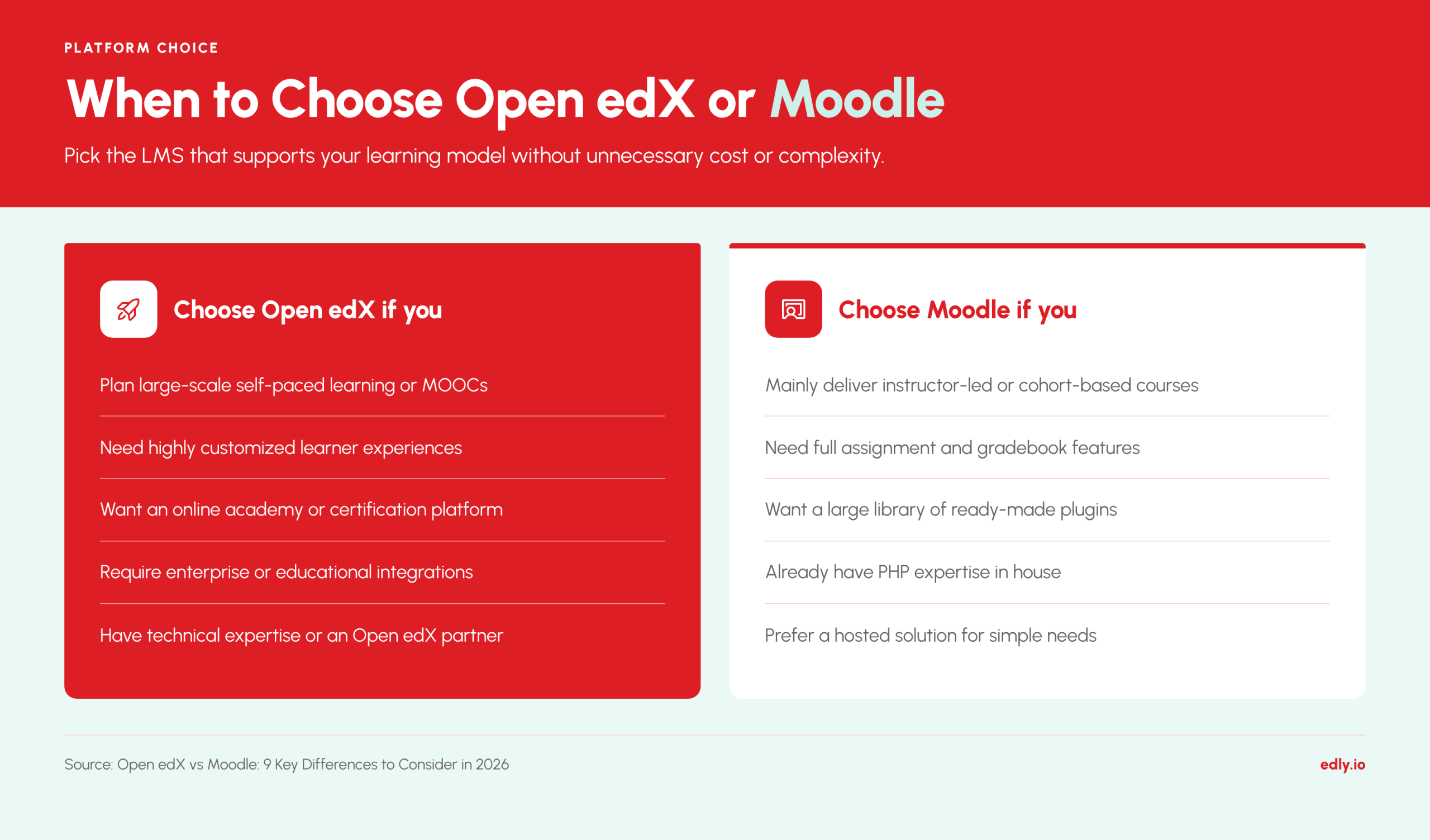
Open edX is worth considering if your organization:
- Plans to offer large-scale self-paced learning or MOOCs.
- Needs highly customized learner experiences.
- Wants to build an online academy or professional certification platform.
- Requires integrations with other enterprise or educational systems.
- Has access to technical expertise or an experienced Open edX partner.
When Should You Choose Moodle?
Moodle may be the better choice if your organization:
- Primarily delivers instructor-led or cohort-based courses.
- Needs comprehensive assignment and gradebook functionality.
- Wants access to a large ecosystem of ready-made plugins.
- Has existing PHP expertise.
- Prefers a hosted solution for relatively straightforward learning requirements.
The best open-source LMS isn’t necessarily the one with the most features. It’s the one that supports your learning model without introducing unnecessary cost or complexity.
Can You Migrate from Moodle to Open edX?
Yes, organizations can migrate from Moodle to Open edX. However, migration usually requires planning because the platforms use different course structures, data models, and activity formats.
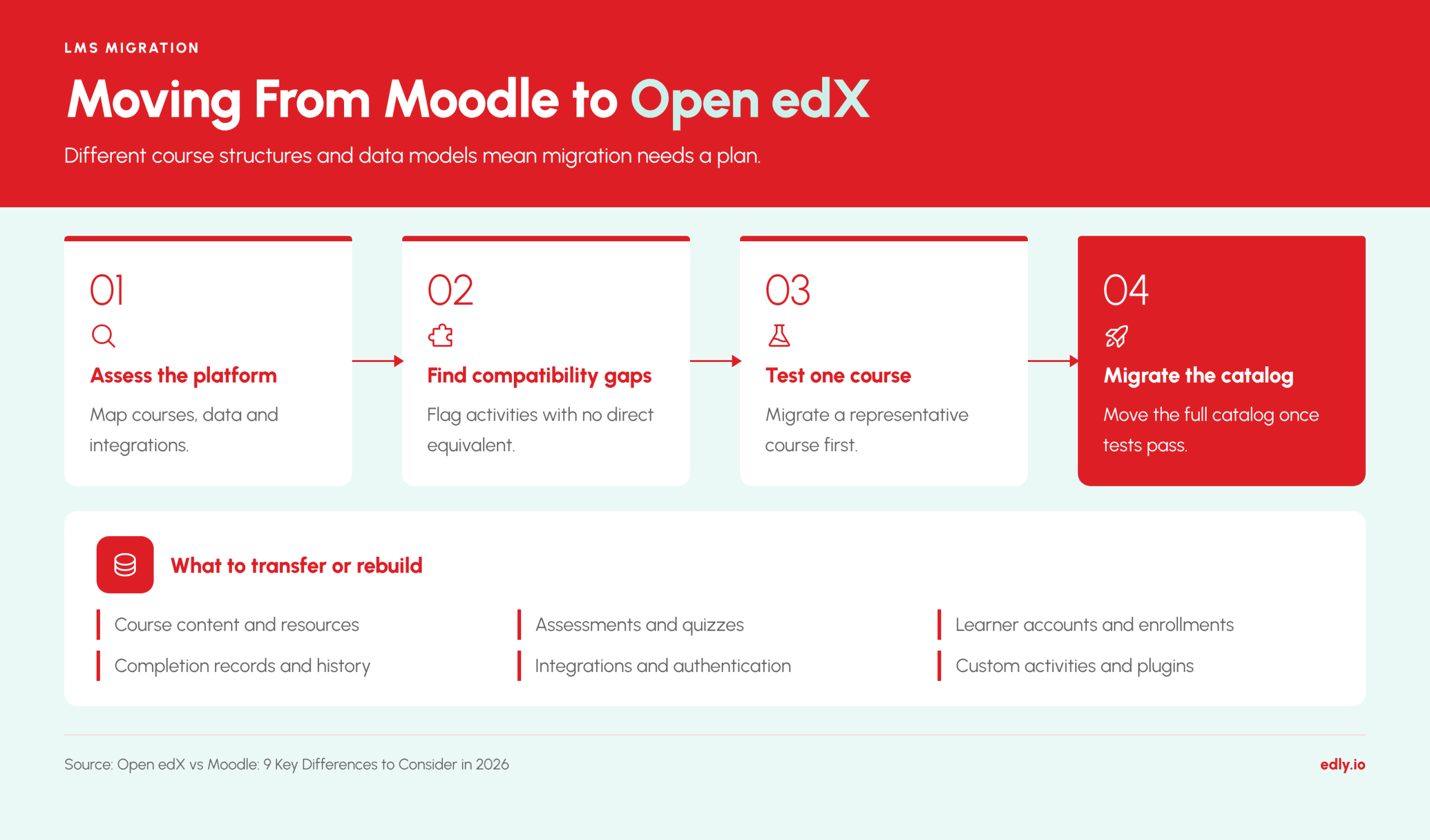
A successful migration may involve transferring or rebuilding:
- Course content and learning resources.
- Assessments and quizzes.
- Learner accounts and enrollment information.
- Completion records and historical learning data.
- Integrations and authentication workflows.
- Custom learning activities and plugins.
Not every Moodle feature has an exact equivalent in Open edX.
For example, certain Moodle-specific assignments, gradebook configurations, or plugin-based activities may need to be redesigned rather than transferred directly.
Organizations should begin with a platform assessment, identify content compatibility issues, and test a representative course before migrating their full catalog.
Working with an experienced Open edX development partner can help reduce technical risks and ensure the new platform supports existing learning requirements.
Final Thoughts: Open edX vs Moodle
Open edX and Moodle are two established open-source learning management systems, each with strengths that serve different organizational needs.
Moodle offers a mature course management environment, extensive plugin support, and a strong foundation for instructor-led learning.
Open edX provides a flexible architecture for interactive, self-paced learning experiences and large-scale digital education programs.
For organizations planning to expand their online learning capabilities, the decision should go beyond a checklist of available features.
Consider how learners will interact with your courses, which integrations you need, the level of customization required, and how your platform will evolve over the next few years.
The right LMS should not only support your learning programs today but also give you room to grow.
Build a Learning Platform That Fits Your Goals with Edly
Whether you’re launching a new online learning platform, customizing an existing Open edX instance, or planning a migration from Moodle, choosing the right implementation approach can make a significant difference.
At Edly, we help organizations build, customize, deploy, and manage Open edX-powered learning platforms aligned with their educational and business requirements.
From managed hosting and platform integrations to custom LMS development and migration support, our team can help you develop a learning environment designed for your goals.
Explore Edly’s Open edX Services and discover how to make your next learning platform more scalable, flexible, and effective.
Frequently Asked Questions About Open edX vs Moodle
Is Open edX better than Moodle?
Open edX is generally better suited to large-scale self-paced online learning, while Moodle is often a stronger choice for instructor-led courses and traditional academic management. Neither platform is universally better. The right choice depends on learning requirements, customization needs, and available technical resources.
Is Open edX free?
Yes. Open edX is open-source software and does not require traditional software licensing fees. However, organizations may still pay for hosting, implementation, customization, integrations, upgrades, and ongoing support.
Can Moodle handle thousands of users?
Yes. Moodle can support thousands of users when deployed on suitable infrastructure. Performance depends on server capacity, database configuration, caching, concurrent usage, and system optimization. Moodle is not limited to small classrooms.
Which is easier to use, Moodle or Open edX?
Moodle may be easier to set up for conventional classroom and course management requirements, especially when using existing plugins or hosted offerings. Open edX may require more technical expertise for initial deployment and extensive customization, although managed hosting can reduce the operational burden.
Does Open edX support SCORM?
Yes. Open edX supports SCORM content through the SCORM XBlock. However, organizations should confirm compatibility with their required SCORM features and test existing packages before migrating course materials.
Can I migrate from Moodle to Open edX?
Yes. Moodle-to-Open edX migration is possible, but the process may require content conversion, course restructuring, learner data mapping, and integration updates. A migration assessment helps identify which components can be transferred and which need to be rebuilt.
Which LMS is better for corporate training?
Both can support corporate training. Moodle and Moodle Workplace are strong choices for structured employee learning and compliance workflows. Open edX is particularly suitable for scalable self-paced academies, professional education, customer training, and customized digital learning programs.
